What Lens to Use for Portraits, Landscapes and Family
Which focal length works for portraits, landscapes, families and groups, how it changes on an APS-C camera and what lens to buy after the 18-55, with charts.
Rodrigo Méndez9 min read
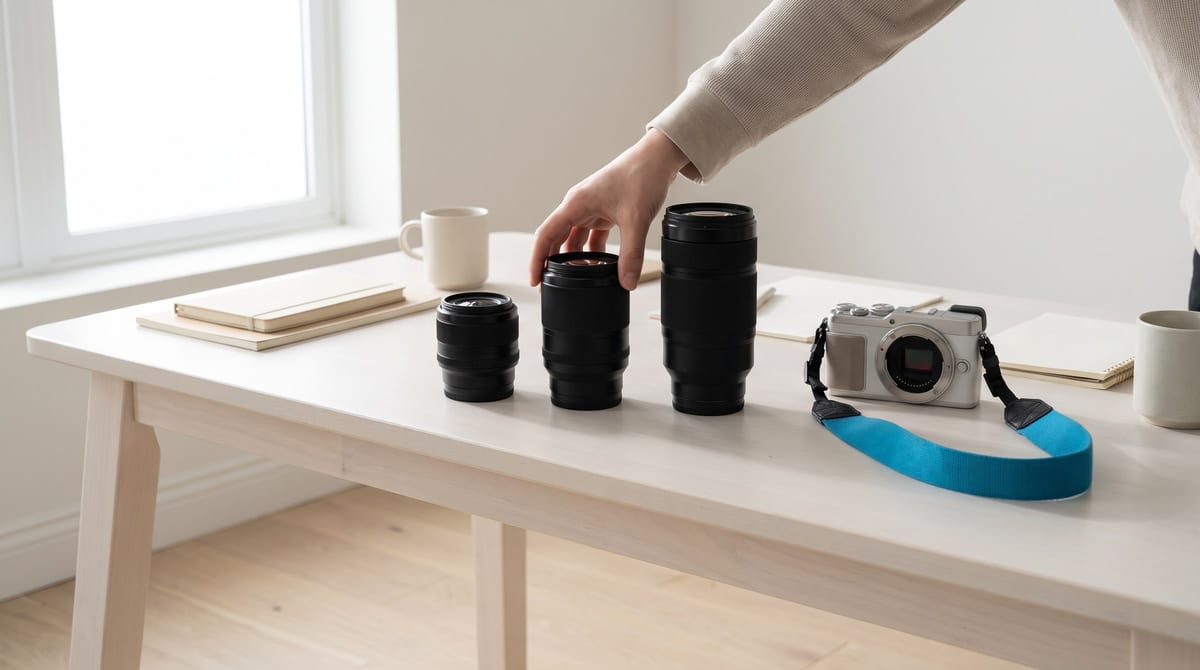
For portraits, use an 85mm lens, or a 50mm if you’re short on space. For landscapes, a wide angle from 16 to 35mm. For families and groups, a 35mm or a 50mm, or a 24-70mm zoom that lets you react fast. Those numbers are for full-frame cameras: if yours is APS-C, which is what most entry-level cameras are, multiply by 1.5 or 1.6 and look for the equivalent lens. Here is the reason behind each choice, with charts to help you decide and a guide to what to buy after the kit lens.
The quick answer, by type of photo
| What you’re shooting | Full frame | APS-C (approximate) | Why |
|---|---|---|---|
| Portrait of one person | 85mm (50 to 135mm) | 50 or 56mm (35 to 85mm) | Natural proportions and a blurred background |
| Landscape | 16 to 35mm | 10 to 24mm | Takes in the whole scene |
| Family and groups | 35 to 50mm, or a 24-70mm zoom | 23 to 35mm, or a 16-50mm zoom | Everyone fits without distorting the people at the edges |
| Weddings and events | 24-70mm and 70-200mm | 16-55mm and 50-135mm | You go from the full scene to a detail without moving |
| Product and food | 50 to 100mm, ideally a macro | 35 to 60mm | Shapes without distortion and close focusing |
| Sports and wildlife | 70-200mm; 300mm and up if it’s far away | 50-135mm; 200mm and up | You fill the frame from a distance |
| The moon | 300mm or more | 200mm or more | With less, it’s a dot |
The ranges come from the Nikon and Canon guides, which agree on the essentials: wide angle for landscape and architecture, 35 to 85mm for everyday shooting and portraits, and telephoto to isolate the subject or reach what’s far away.
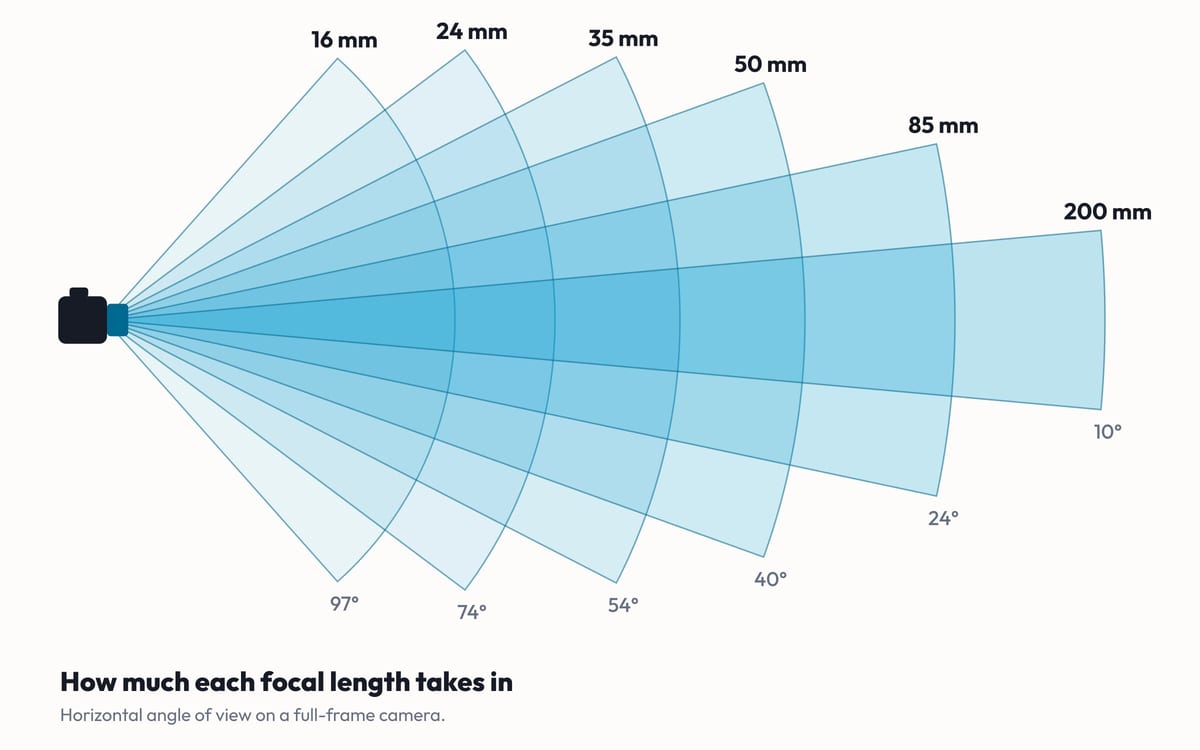
It’s not the lens, it’s the distance
Focal length decides how much the photo takes in. What changes the shape of a face is something else: how close you are. To fill the frame with someone’s head and shoulders, each lens forces you to stand in a different place:
| Focal length | Where you stand | What happens to the face |
|---|---|---|
| 24mm | About 17 in (42 cm) | The nose and forehead grow, the ears almost disappear |
| 35mm | About 2 ft (60 cm) | Some distortion is still visible |
| 50mm | About 3 ft (90 cm) | Natural, close to how you see someone in conversation |
| 85mm | About 5 ft (1.5 m) | Flattering proportions: the portrait classic |
| 135mm | About 8 ft (2.4 m) | Flatter features and a very blurred background |
| 200mm | About 11.5 ft (3.5 m) | A wider, flatter face; the background looks huge and close |
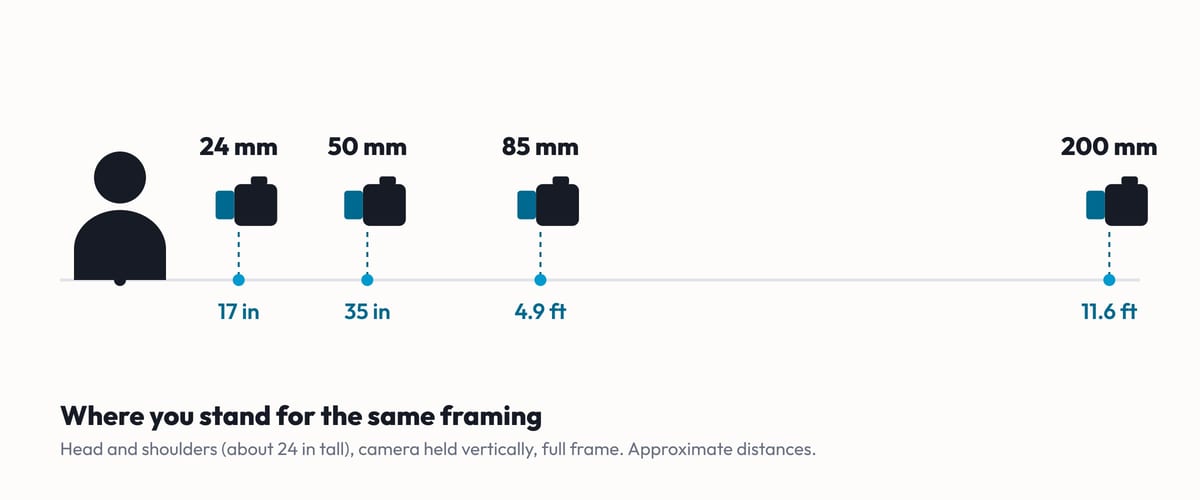
At 17 inches, the nose is much closer to the camera than the ears, so it looks bigger. At 10 feet, that difference barely counts and the face flattens. Canon puts it this way in its focal length guide: with a fixed focal length, the perspective changes only if you move the camera toward the subject or away from it.



The three images are illustrations generated with artificial intelligence to show the effect. The distances in the table are calculated.
A study published in 2012 in the Journal of Vision explains why the 50mm feels “natural”: it’s the focal length at which a photo, viewed from the distance people usually look at it, is perceived without distortion.
Portraits: 50, 85 or 135mm
85mm is the starting point. It leaves you at a comfortable distance for directing, gives flattering proportions and, with a wide aperture, separates the person from the background. If you’re only going to own one portrait lens, make it this one.
50mm when there’s no room. In a small room, an 85mm pins your back to the wall. The 50mm handles half-body and full-body shots and shows some of the place. For a very tight close-up, take a step back and crop later.
35mm for portraits with context. When the place tells part of the story, like a workshop, a kitchen or a street. Keep the person near the center and don’t get too close.
135mm or a 70-200mm to compress the background. The background looks bigger and blurrier, and the person stands out completely. You need space: several feet between you and your subject.
Landscapes: wide angle, but not only
16 to 35mm for the whole scene. Nikon lists ultra-wide lenses, from 8 to 24mm, as the best fit for landscapes, and Canon counts everything up to around 35mm as wide angle: a 16-35mm zoom covers the useful part of both. A wide angle pushes the background away, so you need something interesting up close: a rock, a trail, flowers. Without a foreground, an imposing mountain becomes a line on the horizon.
A telephoto shoots landscapes too. With a 70-200mm you isolate a peak, a line of ridges or a lone tree, and the layers of the background look closer together. It’s the fastest way to make your landscapes stop looking like everyone else’s.
You don’t need the fastest lens. In landscape you almost always shoot stopped down and on a tripod, so an f/4 zoom weighs less, costs less and performs the same. The exception is the night sky, where a wide angle at f/2.8 or wider does help.
Family and groups: fit everyone in, and keep everyone sharp
With a family you change framing all the time: everyone together, the parents, the kids running. That’s why a 24-70mm zoom earns its keep here, or a 35mm if you prefer a prime.
- Don’t get close with an extreme wide angle. Below 24mm, whoever is at the edge of the frame gets stretched. Take two steps back and use 35mm instead.
- Line everyone up at the same distance from the camera. Straight rows need less depth of field than a semicircle.
- Stop down according to the rows. It’s the most common mistake in group photos: people shoot at f/1.8 because the blur looks nice, and the back row comes out soft.
With a 50mm on full frame, focused at 13 feet (4 m), this is how much stays sharp:
| Aperture | Zone of sharp focus | What it’s enough for |
|---|---|---|
| f/1.8 | 12.1 to 14.3 ft (2.3 ft) | One person, or two at the same distance |
| f/2.8 | 11.6 to 15.1 ft (3.5 ft) | One row |
| f/5.6 | 10.4 to 17.9 ft (7.5 ft) | Two rows |
| f/8 | 9.5 to 21.1 ft (11.6 ft) | Three rows or more |
Focus on someone in the front row if there are two rows, and on the middle row if there are three.
Weddings and events: two zooms cover almost everything
At an event you can’t ask people to repeat the moment or keep swapping lenses. The classic combination is a 24-70mm for what happens close by, like the ceremony, the tables and the groups, and a 70-200mm for what happens far away, like reactions, details and portraits without interrupting. Both at f/2.8, because venues tend to be dim.
If you prefer primes, a 35mm and an 85mm cover almost the same ground with less weight and more light. In exchange, you move more.
If your camera is APS-C, multiply
Almost every entry-level camera has an APS-C sensor, smaller than full frame. That sensor crops the center of the image, so the same lens takes in less. That’s the crop factor: 1.5 on Nikon, 1.6 on Canon, and one of those two values on almost every other brand. On Micro Four Thirds cameras it’s 2.
| Lens | On 1.5x APS-C | On Canon APS-C (1.6x) | On Micro Four Thirds (2x) |
|---|---|---|---|
| 10mm | 15mm | 16mm | 20mm |
| 18mm | 27mm | 29mm | 36mm |
| 24mm | 36mm | 38mm | 48mm |
| 35mm | 53mm | 56mm | 70mm |
| 50mm | 75mm | 80mm | 100mm |
| 85mm | 128mm | 136mm | 170mm |
| 200mm | 300mm | 320mm | 400mm |
The lens doesn’t change: a 50mm is still a 50mm. What changes is how much of the scene your sensor uses. That’s why, on APS-C, the classic portrait lens is a 50 or 56mm and the everyday lens is a 35mm.
What lens to buy after the 18-55
The 18-55mm that comes with the camera is equivalent to a 27-82mm on a 1.5x APS-C body: it works for almost everything and stands out at nothing. Its limit is light, because at its long end it usually opens only to f/5.6. The next lens depends on what you shoot most:
- People: a 50mm f/1.8. On APS-C it frames like a 75 or 80mm and lets in about ten times more light than the kit lens at f/5.6. It’s the upgrade you notice most for the money.
- A bit of everything, family and travel: a 35mm f/1.8, roughly a 50mm equivalent on APS-C.
- Landscape and architecture: a wide angle from 10 to 20mm.
- Your kids’ sports, wildlife or the moon: a 55-200mm or a 70-300mm.
- Product and details: a 60mm macro.
One well-chosen lens teaches you more than three bought just in case. Use the new one for a month before you think about the next.
Prime or zoom
| Type | In favor | Against |
|---|---|---|
| Prime | More light for less money, lighter, makes you move | A single framing: if it doesn’t fit, you walk |
| Zoom | You change framing without moving, ideal when everything happens fast | Heavier and more expensive for the same aperture |
Neither is better. For planned sessions, like portraits or product, a prime gives you more. For events, travel and kids, the zoom wins.
Common mistakes when choosing a lens
- Shooting close-ups with a wide angle and blaming the camera when the face looks odd.
- Photographing groups at f/1.8 and losing the back row.
- Buying by the millimeters recommended by someone with a different sensor size.
- Thinking landscape is only done with a wide angle.
- Changing lenses hoping it will fix the light, the pose or the composition.
Once you have the photos, what comes next is delivering them well and charging for them well: here are the guides on how to deliver photos to clients and how much to charge for a photoshoot.
Sources
- Nikon, “What is focal length?”, https://www.nikon.es/es_ES/learn-and-explore/magazine/tips-and-tricks/what-is-focal-length-in-photography-a-guide-for-beginners, published June 9, 2026 and accessed October 3, 2026.
- Nikon, “What is crop factor and how do I calculate it? DX and FX explained”, https://www.nikon.es/es_ES/learn-and-explore/magazine/tips-and-tricks/what-is-crop-factor-and-how-do-i-calculate-it-dx-and-fx-explained, published June 21, 2024 and accessed October 3, 2026.
- Nikon, “How to take great images of the moon”, https://www.nikon.es/es_ES/learn-and-explore/magazine/tips-and-tricks/how-to-take-great-images-of-the-moon, published August 3, 2026 and accessed October 3, 2026.
- Canon Europe, “Understanding focal length”, https://www.canon-europe.com/pro/infobank/understanding-focal-length/, accessed October 3, 2026.
- Canon Europe, “APS-C vs full-frame”, https://www.canon-europe.com/get-inspired/tips-and-techniques/aps-c-vs-full-frame/, accessed October 3, 2026.
- Adorama, “What Is Crop Factor And How Do You Calculate It?”, https://www.adorama.com/alc/what-is-crop-factor-everything-you-need-to-know/, accessed October 3, 2026.
- Adorama, “The Best Lenses for Product Photography”, https://www.adorama.com/alc/7-best-lenses-for-product-photography/, accessed October 3, 2026.
- Emily A. Cooper, Elise A. Piazza and Martin S. Banks, “The perceptual basis of common photographic practice”, Journal of Vision, vol. 12, no. 5, 2012, https://doi.org/10.1167/12.5.8.
- DOFMaster, “Depth of Field Equations”, https://www.dofmaster.com/equations.html, accessed October 3, 2026. The table of sharp focus is our own calculation with those formulas and a circle of confusion of 0.03 mm.
Frequently asked questions
Is a 50mm or an 85mm better for portraits?
The 85mm if you have room to step back 5 feet or more: it gives flattering proportions and separates the background better. The 50mm if you work in small rooms or want full-body shots with some context. On an APS-C camera, a 50mm already frames like a 75mm or an 80mm.
35mm vs 50mm: which should I get?
The 35mm takes in more: it works for families, groups, street and portraits with context. The 50mm tightens the frame and works better for half-body shots. On an APS-C camera, a 35mm is roughly a 50mm equivalent and makes a good everyday lens.
What lens should I use for group photos?
Between 35 and 50mm on full frame, or a 24-70mm zoom. Avoid getting close with an extreme wide angle, because it stretches whoever is at the edges, and stop down to f/5.6 or f/8 so every row comes out sharp.
What lens should I buy after the 18-55 kit lens?
A 50mm f/1.8: it's usually among the most affordable lenses in each brand, and on APS-C it frames like a 75 or 80mm portrait lens, with far more light and background blur. If you'd rather have one lens for everything, a 35mm f/1.8.
What lens do I need to photograph the moon?
Nikon recommends at least 300mm on full frame or 200mm on an APS-C camera. With less, the moon comes out as a small dot. A tripod helps keep it from blurring.
Can I use a full-frame lens on an APS-C camera?
Yes, if the mount is compatible. The crop factor applies either way: Canon notes that its 1.6x factor holds for full-frame lenses and for lenses designed for APS-C alike.